Prompt Engineering Guide: RTF, CRISPE, and COSTAR Frameworks Explained
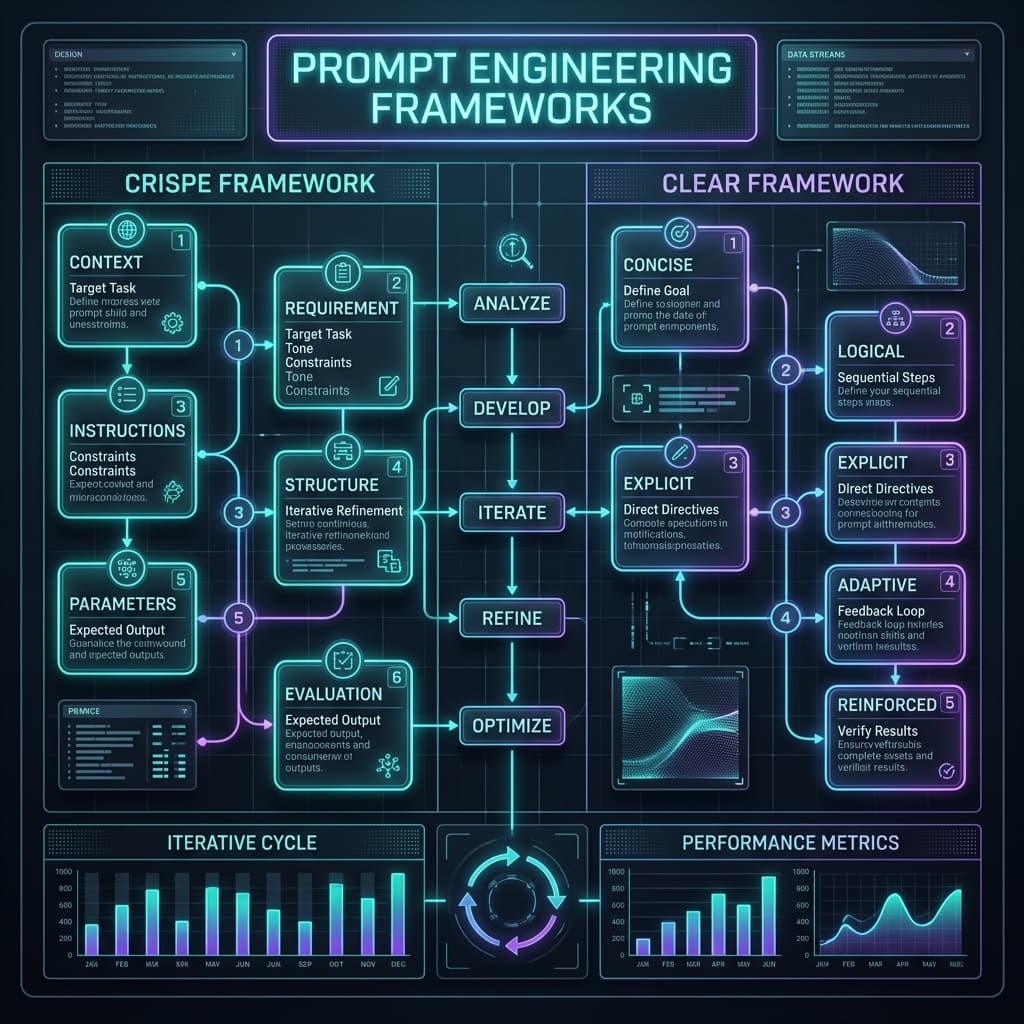
Quick Answer: The best prompt engineering frameworks to structure AI inputs are RTF, CRISPE, and COSTAR. They provide the mental scaffolding needed to ensure any LLM returns reliable, high-signal results. The three leading frameworks are:
- RTF (Role, Task, Format): Quick and transactional.
- CRISPE (Capacity, Role, Insight, Statement, Personality, Experiment): Behavioral and persona-driven.
- COSTAR (Context, Objective, Style, Tone, Audience, Response): Marketing-centric and outcome-oriented.
Writing prompts without a structure is like coding without design patterns—you end up with messy, unpredictable inputs that yield inconsistent results.
To help developers, marketers, and creators write structured prompts, AI practitioners have established standardized frameworks. These frameworks ensure that you define the model's persona, provide necessary background context, and enforce formatting constraints on every request.
Here is the complete guide to the three most popular prompt engineering frameworks: RTF, CRISPE, and COSTAR.
1. The RTF Framework: Quick & Transactional
The RTF (Role, Task, Format) framework is the most popular, lightweight prompting structure. It is designed for everyday tasks where speed is key.
The RTF Formula:
- Role (R): The expert persona the model should adopt.
- Task (T): The specific action or output you want the model to perform.
- Format (F): The layout or style of the output.
RTF Example:
"Act as a SQL Database Admin [Role]. Write a database migration script to add a user profile table with email and timestamp fields [Task]. Output the response in a clean markdown code block with inline comments [Format]."
2. The CRISPE Framework: Behavioral & Persona-Driven
The CRISPE framework, popularized by Denys Dinkevych, is designed for prompt engineers looking to build complex, multi-turn behaviors, mock user persona testing, or high-fidelity creative writing.
The CRISPE Formula:
- Capacity (C): The expertise or credential of the LLM.
- Role (R): The specific persona within that capacity.
- Insight (I): Background information or dataset context.
- Statement (S): The exact directive or task to complete.
- Personality (P): The style, energy, and communication tone of the response.
- Experiment (E): Directing the model to generate multiple options or variations (crucial for finding the best output).
CRISPE Example:
[Capacity] Elite growth marketing firm.
[Role] Act as a landing page copywriter specializing in micro-SaaS.
[Insight] We are launching a browser extension that optimizes AI prompts for creators.
[Statement] Write 3 alternative hero headlines and subheadlines targeting freelance writers.
[Personality] Write in a direct, confident style, avoiding generic corporate hype.
[Experiment] For each option, provide a brief note explaining the psychological buying trigger.
3. The COSTAR Framework: Outcome & Marketing-Oriented
Designed by Sheila Teo for Singapore's National GPT-4 Prompt Engineering Competition (where it won first place), the COSTAR framework is highly detailed and structured. This makes it the industry standard for business analysis, content creation, and copywriting.
The COSTAR Formula:
- Context (C): Providing background information about the project, business, or task.
- Objective (O): The target outcome you want to achieve.
- Style (S): The writing style or structural pattern (e.g. mimic a specific author or format).
- Tone (T): The emotional vibe or attitude (e.g. professional, empathetic, humorous).
- Audience (A): The target reader profile (so the model knows the appropriate complexity).
- Response (R): The final layout or structure of the output.
COSTAR Example:
=== CONTEXT ===
We are launching a new premium pricing plan for our AI template dashboard.

=== OBJECTIVE ===
Write a product announcement email to our existing free subscribers.

=== STYLE ===
Direct response copywriting, focusing on the PAS (Problem, Agitate, Solve) framework.

=== TONE ===
Persuasive, helpful, and appreciative of their early support.

=== AUDIENCE ===
Freelance copywriters and digital agency owners who struggle with time management.

=== RESPONSE ===
A subject line options list, followed by the email body divided with clean spacing and a clear primary Call to Action.
Framework Comparison Table
Below is a comparison of when to use each prompting framework:
| Framework | Origin/Creator | Complexity | Best For | Key Strengths |
|---|---|---|---|---|
| RTF | Industry Standard | Low | Fast scripts, code blocks, summarizations, quick queries | Ultra-fast to write; highly transactional. |
| CRISPE | Denys Dinkevych | High | Mock user testing, creative writing, behavioral agents, complex personas | Strong focus on personality and multi-variant responses. |
| COSTAR | Sheila Teo | Medium-High | Copywriting, marketing campaigns, content plans, business analysis | Excellent for aligning intent, style, and target audience. |
Regardless of the framework you choose, you should also apply advanced prompting patterns like Few-Shot Prompting or Chain of Thought to guide the model's logic. Learn how to implement these structures in our complete chain-of-thought prompting guide and explore advanced prompting techniques.
Automate Framework Prompts Instantly
Structuring prompts according to RTF, CRISPE, or COSTAR manually can be tedious.
At PromptBuff, our template builder incorporates these exact frameworks. When you create a prompt in the PromptBuff dashboard, the platform compiles your inputs automatically—allowing you to save context, roles, and formats as reusable variables. Our Chrome extension overlays these structures directly inside ChatGPT, Claude, and Gemini, ensuring you get high-fidelity outputs every time.
Optimize your prompting pipeline. Sign up for PromptBuff.app today.
Continue reading: How to Write Better AI Prompts: The Starter Guide · Advanced Prompting Techniques for Professional Workflows
Frequently Asked Questions (FAQ)
What is the RTF prompt framework?
RTF stands for Role, Task, and Format. It is the simplest and most lightweight prompting framework, ideal for fast, everyday tasks like drafting emails, writing basic code scripts, or summarizing text blocks.
What is the CRISPE prompt framework?
CRISPE stands for Capacity, Role, Insight, Statement, Personality, and Experiment. It is a highly detailed, behavior-focused framework designed to help you create complex personas, mock interviews, or creative writing styles.
What is the COSTAR prompt framework?
COSTAR stands for Context, Objective, Style, Tone, Audience, and Response. Originally engineered for competitive AI prompting challenges, it is highly structured and excels in marketing copywriting, business planning, and conversion copywriting.
Which prompting framework is the best?
There is no single 'best' framework. Use RTF for fast, transactional tasks. Use COSTAR for marketing campaigns, content strategies, and business briefs. Use CRISPE for complex behavioral simulations, user testing, or interactive role-play.