From Prompt Engineering to Loop Engineering: The Next Frontier of AI Workflows
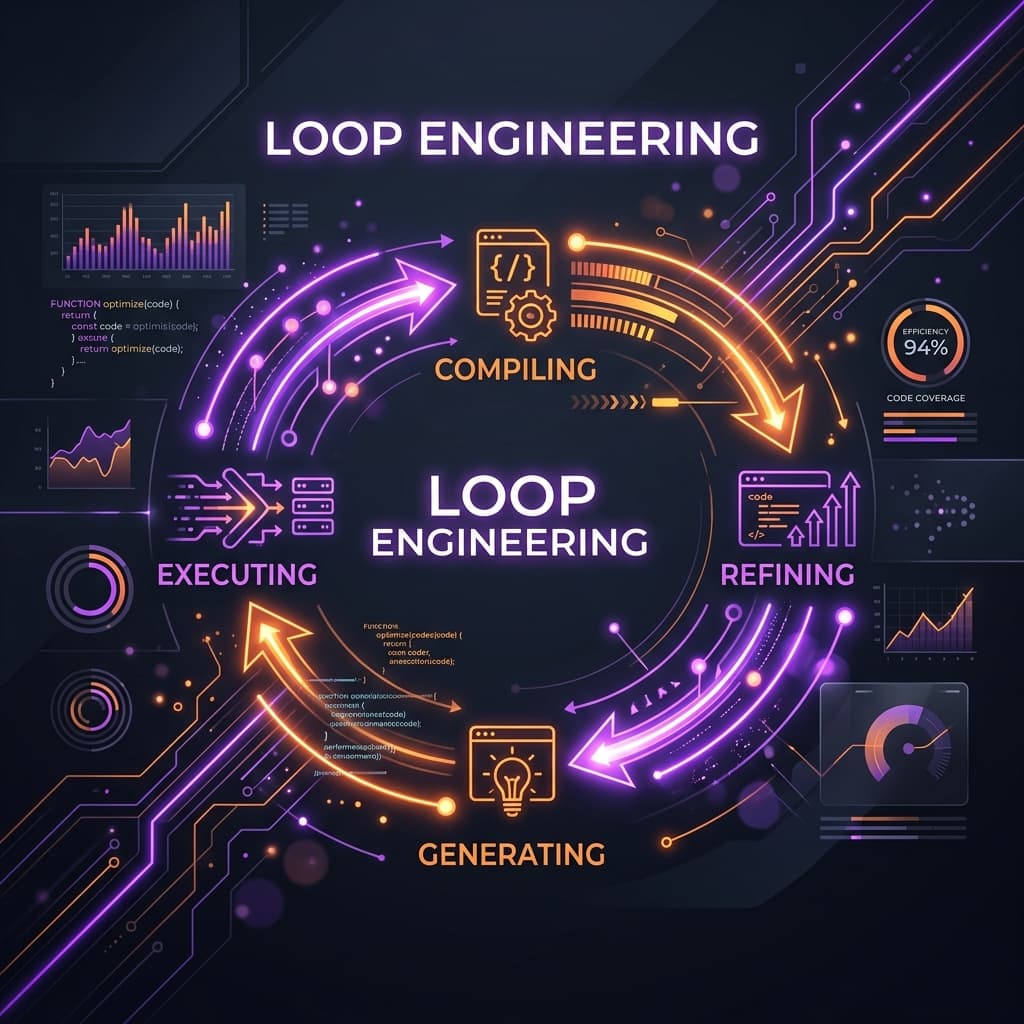
Quick Answer: The AI industry is transitioning from manual "prompt engineering" to autonomous "loop engineering." Coined by industry builders like Boris Cherny, creator of Claude Code at Anthropic, loop engineering involves building software environments where AI agents autonomously write, test, evaluate, and chain prompts through closed-loop feedback systems rather than relying on human developers to manually craft individual instructions.
If you are still manually tweaking single prompts in a chat window, you are practicing a dying art.
The AI engineering landscape is changing at breakneck speed. Industry leaders and builders, including Boris Cherny—the creator of Anthropic's Claude Code—have recently outlined a profound evolution in how we build applications with Large Language Models (LLMs).
The paradigm is shifting along a very clear trajectory:
Prompt Engineering → Agent Engineering → Context Engineering → Loop Engineering
Crafting the perfect individual prompt is no longer the core problem. The future belongs to Loop Engineering—the science of building automated systems where AI agents generate, refine, and chain prompts autonomously through closed feedback loops.
Here is a deep dive into what loop engineering is, how it works, and why it is the defining development pattern of the next decade.
The Death of the Single Prompt
Traditional prompt engineering treats the LLM as a single-step function: you give it an input, and it gives you an output. If the output is wrong, a human has to manually rewrite the prompt and try again.
This approach fails at scale because:
- It is slow: Human iteration loops take minutes or hours.
- It is fragile: A prompt that works for one model update might break on the next.
- It is non-scalable: You cannot manually write a unique prompt for every single dynamic user query in a complex application.
In early 2025, Andrej Karpathy coined the term "vibe coding" to describe the experience of casually chatting with an AI to build small web apps without understanding the underlying code. While vibe coding served as an exciting experimental playground, it falls apart under the weight of enterprise deployments. Loop engineering is the mature, production-grade successor to vibe coding. Instead of relying on a human manually prompting a model back and forth, loop engineering builds unattended, automated infrastructure where the system continues running, compiling, testing, and self-correcting even after you close your laptop.
What is vibe coding?
Vibe coding is the informal practice of building software by casually prompting a large language model without a structured engineering workflow or deep understanding of the underlying codebase.
As Boris Cherny recently argued, the future of AI is not about human prompt writers or "vibing" through a chat interface. It is about systems of agents. In these systems, one agent's output becomes another agent's input, and the prompts governing these transitions are generated, optimized, and validated autonomously.
What is Loop Engineering?
Loop engineering is the design of closed-loop execution environments for AI. Instead of expecting an LLM to output a perfect answer on the first attempt, loop engineering establishes an iterative, multi-step process where the system continuously evaluates and refines its work until it meets a predefined success metric.
A classic loop engineering architecture consists of four distinct stages:
graph LR
    A[1. Generate] --> B[2. Execute]
    B --> C[3. Evaluate]
    C --> D[4. Optimize / Correct]
    D --> B
- Generate: A coordinator agent generates a draft prompt or plan based on the user's objective.
- Execute: An executor agent runs the prompt, calling APIs, running code, or fetching files.
- Evaluate: The system verifies the execution. While early agent structures relied on "critic agents" (using LLMs to evaluate other LLMs, which causes cost bloat and infinite loops), modern loop engineering enforces deterministic verification gates—such as automated compilers, unit test runners, or JSON schema validators—as the ultimate ground-truth validator.
- Optimize / Correct: If the validator finds issues, it sends the feedback back to the generator, which refines the prompt and runs the loop again.
By allowing the AI to run this cycle autonomously, the system can self-correct and solve tasks that would be impossible to address in a single-turn interaction.
Loop Engineering in Practice: A Coding Agent Example
Consider a software engineering agent tasked with fixing a bug in a codebase. A simple prompt like "Fix the bug in this file" often fails. A loop engineering approach structure, however, handles it systematically:
- Turn 1 (Execution): The agent writes a candidate code patch.
- Turn 2 (Evaluation): An automated test runner executes the test suite. It returns a stack trace showing a new failing test.
- Turn 3 (Self-Critique): A critic agent analyzes the code patch and the stack trace, identifying a race condition.
- Turn 4 (Refinement): The critic agent generates a new, highly specific prompt instructing the executor agent how to resolve the race condition.
- Turn 5 (Re-Execution): The executor agent applies the fix, and the tests pass. The loop terminates successfully.
Throughout this entire process, no human had to write a prompt. The prompts were generated, evaluated, and adjusted dynamically inside the loop.
Designing High-Performance Loops
To build successful loop architectures, developers must focus on three core principles:
1. Hard, Measurable Guardrails
A loop must know when to stop. Without clear validation schemas or deterministic checks (like running a compiler or validating a JSON schema), the agent can get stuck in infinite loops, burning API credits. Every loop needs a maximum iteration count and an objective, verifiable exit condition.
2. State and Context Management
As the loop executes, the system must retain state. The agent needs to remember what it tried in iteration 1 so it doesn't repeat the same mistake in iteration 3. This is where Context Engineering matches with loop engineering—structuring the history of iterations so the agent can learn from its own context.
Managing Comprehension Debt
As background agent loops run autonomously, generating and refining hundreds of lines of code or content unattended, a new challenge emerges: Comprehension Debt. This is the gap between what exists in production (written by the loop) and what the human engineer actually understands. To manage comprehension debt, loop design must include structured audit trails, semantic logs, and clear summaries of changes that allow developers to review agent reasoning and verify codebase integrity quickly.
What is comprehension debt in AI engineering?
Comprehension debt is the knowledge gap that arises when autonomous AI systems generate large volumes of software code or content that human engineers have not yet reviewed or fully understood.
3. Latency and Cost Containment
Because loop engineering requires multiple execution turns per task, costs and latency can quickly escalate. To prevent runaway loops from running infinitely on a broken script and burning thousands of dollars in a single background thread, developers must enforce strict Tool-Call Budgets (e.g., maximum 10-15 tool calls per iteration task). Additionally, you should optimize loops using lightweight models for basic validations and leverage Prompt Caching to avoid paying full price for repeating static codebase contexts.
The Role of PromptBuff in Loop Engineering
As AI workflows become more agentic and loop-driven, the developer's role moves from writing prompts to orchestrating loops. You need tools to monitor, version, and test the templates that govern these autonomous loops.
This is where PromptBuff excels. It provides:
- Version Control for Agent Templates: Ensure that as your autonomous loops evolve, the underlying system prompts and evaluation guidelines are tracked and easily rollable.
- Automated Evaluation Pipelines: Test your loop configurations against test datasets before deploying them to production.
- Real-Time Latency and Cost Analytics: Monitor how many loops your agents are running per task and identify bottlenecks in your agentic workflows.
The era of writing static prompts is ending. The era of orchestrating autonomous, self-correcting loops is here. Explore PromptBuff to orchestrate your AI templates.
Continue reading: When AI Builds Itself: The Rise of Recursive Self-Improvement (RSI) · Effective Context Engineering: Moving Beyond Basic Prompting for AI Agents